Edge Geometry — The Part of the Knife Nobody Talks About

Arthur J. Hannigan
April 10, 2025
Steel hardness and sharpness get all the attention. But it is the geometry behind the edge that determines how a knife actually cuts.
Ask someone what makes a good knife and they will talk about the steel — the alloy, the hardness, whether it is stainless or carbon. Ask a bladesmith and they will talk about geometry first.
Edge geometry is the shape of the blade in cross-section, from spine to edge. It determines how the knife moves through food, how much force you need, how the edge behaves under load, and how long it stays sharp. It is the difference between a knife that slices and one that wedges.
The Primary Grind
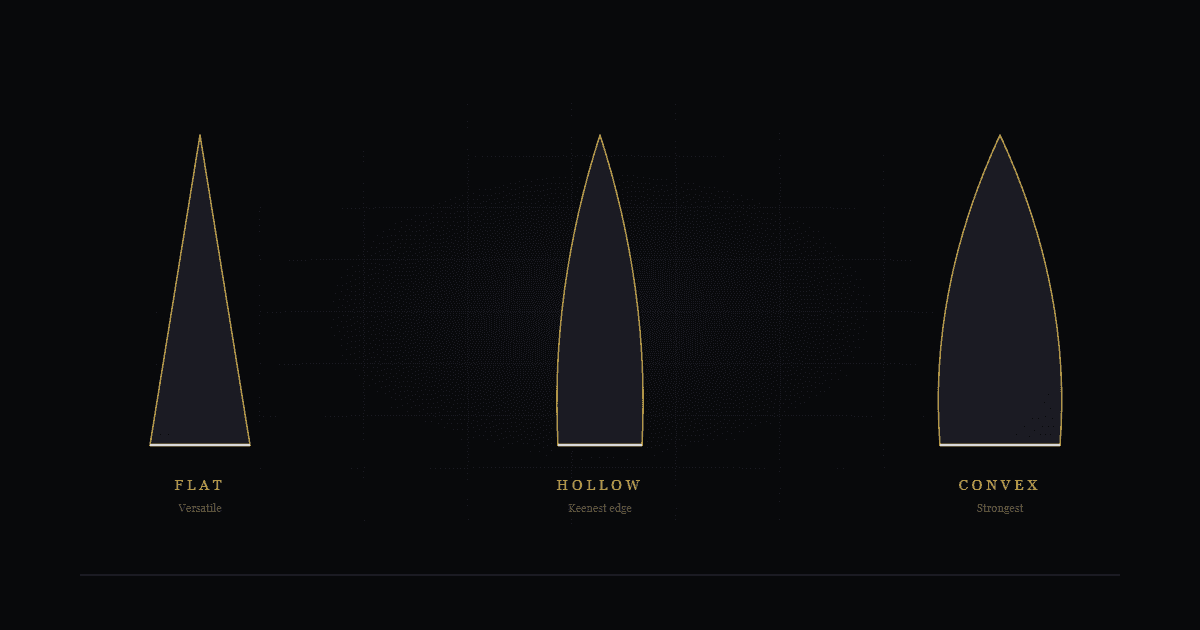
The primary grind is the overall profile of the blade from spine to edge. The most common grinds are flat, hollow, and convex.
A flat grind — where the blade tapers in a straight line from spine to edge — is the most versatile geometry for kitchen knives. It provides a good balance of strength and cutting efficiency, is relatively easy to sharpen, and performs well across a range of cutting tasks.
A hollow grind has a concave cross-section — the sides of the blade curve inward toward the edge. This creates a very thin edge geometry that cuts with minimal resistance and takes a keen edge. The trade-off is fragility: hollow-ground edges are more prone to chipping under lateral stress or hard contact.
A convex grind curves outward, creating a rounded cross-section. This is the strongest geometry — the mass of steel behind the edge resists chipping and rolling. It is the preferred grind for splitting wood and heavy outdoor work. It requires a different sharpening technique (freehand on a flat stone rather than at a fixed angle) and is less common in kitchen knives.
The Secondary Bevel
The secondary bevel — also called the edge bevel — is the small angled face that meets at the cutting edge itself. On most knives, this is the part you are sharpening when you use a whetstone.
The angle of the secondary bevel determines the edge characteristics: a shallow angle (12–15°) gives a razor-keen edge that cuts effortlessly but is more fragile; a steeper angle (20–25°) gives a more robust edge that handles harder use but requires more force to cut.
Kitchen knives typically run 15–17° per side. Hunting and outdoor knives, 18–22°. Splitting tools and choppers, 25° or more. These are not arbitrary numbers — they reflect the expected use and the required balance between sharpness and durability.
Why Geometry Matters More Than Steel
A mediocre steel with excellent geometry will often outperform excellent steel with poor geometry. This is the part of knife performance that is hardest to see and easiest to overlook when buying.
When a knife feels like it "falls through" food with minimal effort — onion, tomato, protein — that is geometry at work as much as sharpness. The thin cross-section behind the edge creates low cutting resistance. The blade does not push food apart; it parts it.
A thick blade ground to a sharp edge will still wedge and split rather than slice. You will feel the resistance in your wrist. No amount of sharpening changes the cross-section of a blade — only grinding does.
What We Do at the Forge
Every blade we make is hand-ground after forging, with the geometry set deliberately for the intended use. A chef's knife gets a flat to slight hollow grind with a thin primary bevel — optimised for slicing efficiency. A hunting knife gets a fuller flat grind with a more robust secondary bevel — optimised for durability in field conditions. A boning knife gets a narrow, flexible profile that follows bone and sinew.
When we sharpen a blade before it leaves the forge, we are setting a geometry that should be maintained through the life of the knife. That is what we mean when we say the knife is finished — not just sharpened, but set.
More from the Journal