Handle Materials — A Guide to What Goes in Your Hand
Arthur J. Hannigan
April 1, 2025
The handle is where the knife meets the person. Wood, micarta, G10, antler — every material makes a different promise.
Most people choose a knife by looking at the blade. Then they pick it up, and what they actually notice is the handle. The balance, the warmth, the texture under the palm — the handle is the knife's handshake. It matters as much as the steel.
Here is what the major handle materials offer, and where each one makes the most sense.
Stabilized Wood Burl
Stabilized wood is natural wood that has been vacuum-impregnated with resin under pressure. The process fills the cellular structure of the wood, hardening it, making it waterproof, and locking in the colour and figure permanently.
The result is a handle that has all the warmth and visual character of natural wood — maple burl, amboyna, box elder — without the vulnerabilities. Stabilized handles will not swell, crack, or absorb moisture. They can be finished to a high gloss or a satin texture and take on extraordinary colour from the resin.
For kitchen use, stabilized burl is our most common recommendation. It handles heat, moisture, and extended use without complaint, and no two pieces are identical.
Natural Wood
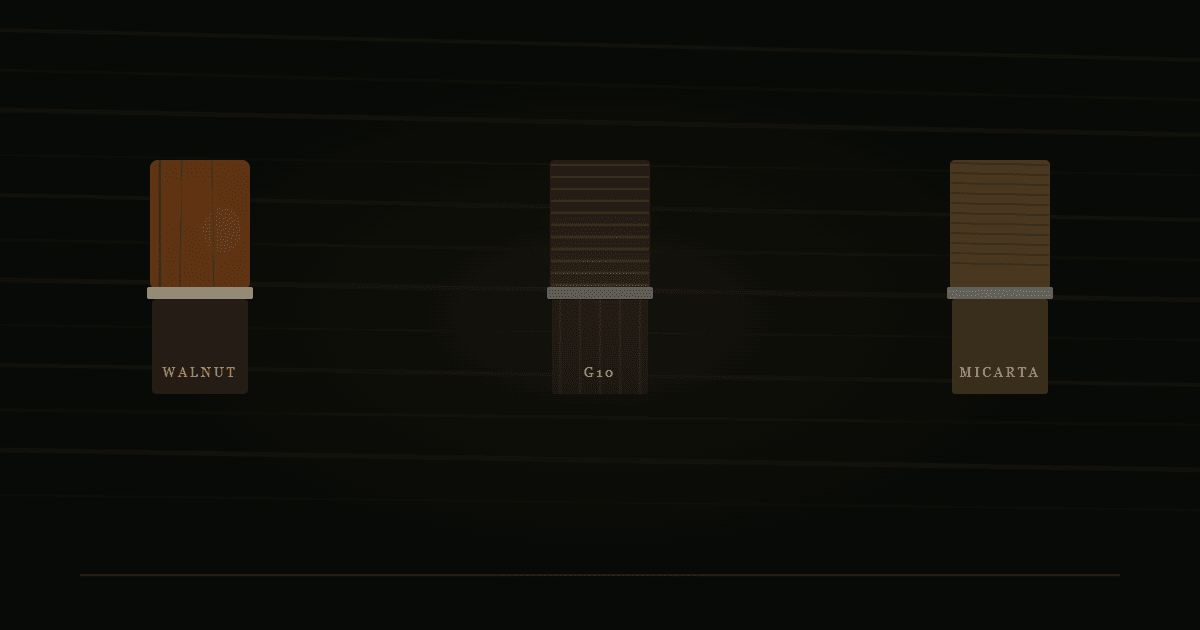
Unstabilized natural wood — walnut, olive wood, rosewood, cocobolo — has a warmth and character that no synthetic material matches. The grain moves. The weight feels right. Over years of use, the surface develops its own patina.
The trade is maintenance. Natural wood handles need occasional oiling with food-grade mineral oil to stay conditioned. They should not be soaked or left wet. In a working kitchen that treats equipment well, natural wood handles are entirely practical. In a commercial kitchen with dishwashers and brine, they are the wrong choice.
Micarta
Micarta is a composite material made from layers of fabric — linen, canvas, burlap — saturated with resin and compressed under heat and pressure. It is one of the most durable handle materials available: nearly indestructible, impervious to moisture, and with a texture that provides excellent grip even when wet.
Linen micarta has a warm tan-brown colour and subtle texture. Canvas micarta is slightly coarser. Both are workhorses — they are the handle material of choice on heavy-use outdoor and hunting knives because they survive conditions that would destroy wood or synthetic materials.
The one thing micarta lacks is visual drama. It is handsome in a functional, understated way. If you are choosing a handle for display as much as use, look elsewhere. If you are choosing a handle for a knife that will work hard in cold, wet conditions, micarta is difficult to argue with.
G10
G10 is a fibreglass laminate — similar in construction to micarta but using glass fibres rather than fabric. It is harder, more rigid, and available in a wider range of colours and textures.
G10 has become the standard handle material for tactical and EDC knives because of its dimensional stability (it does not expand or contract with temperature), its resistance to chemicals, and its grip texture. It is also lighter than most natural materials.
For kitchen use it is less common — the texture can be aggressive on extended use, and it lacks the aesthetic warmth of wood. For a working outdoor knife or EDC blade that will see hard use and infrequent maintenance, black or olive G10 is a serious choice.
Antler and Natural Materials
Stag antler, bone, and horn handles are the oldest knife handle materials and remain some of the most visually distinctive. Antler in particular — with its cream and amber colouration, natural texture, and unique form — makes a knife look like what it is: a made object with a history.
These materials require care. They can dry out and crack without occasional conditioning. They are not appropriate for knives that will be submerged or used in wet conditions for extended periods. They are entirely appropriate for a collector's piece, a gift, or a hunting knife that is carried with pride and maintained with attention.
When we use antler or bone on a custom knife, we select pieces personally for consistency of colour, absence of checks or cracks, and the way they sit in the hand. The result is a handle that is irreplaceable — the same material will never exist twice.
More from the Journal